
Audience. This course is written for working geoexchange and water well drillers, their crews, and the contractors, engineers, specifiers, and regulators who share responsibility for the bores they construct.
0.1 How we got here
Geothermal exchange drilling grew up inside the water well industry, and for decades that arrangement made sense. Bores were shallow — a few hundred feet — drilled with water well rigs, water well methods, and water well assumptions.
That era is ending. Modern geoexchange drilling runs on substantially more drilling horsepower, better bits, better rigs, and techniques that are real improvements over the older water well methods. In the authors’ observation, typical bores still fall between roughly 300 and 600 feet, but a fast-growing segment of the work now reaches 1,000 feet and beyond. Many bores now pass below potable aquifers. The risk to the public is therefore no longer limited to the surface expression of an influx; it extends to the damage or pollution of the aquifers.
The equipment evolved. The depths evolved. Well control has not evolved proportionally.
Influx does not only mean methane gas. A well or bore can deliver flowing artesian water, brine, oil, hydrogen sulfide, carbon dioxide, and other toxic or contaminating fluids. Some burn. Some poison. From here forward, when this course says “influx,” it means any or all of them; where a specific fluid matters, the course names it.
0.2 The record
The reason for this course stems from real-world incidents that tragically affected life, health, property, and the environment. These summaries are not intended to inflame or enrage the reader. Rather, they anchor the course in the reality of the consequences of doing nothing, and they reinforce the duty that drillers, engineers, and regulators owe to one another and to the public. Each summary reflects the public record as of July 2026; where an investigation remains open, this course states so, draws no conclusions about cause, and commits to publishing corrections in its errata when official findings appear.
Consider the following:
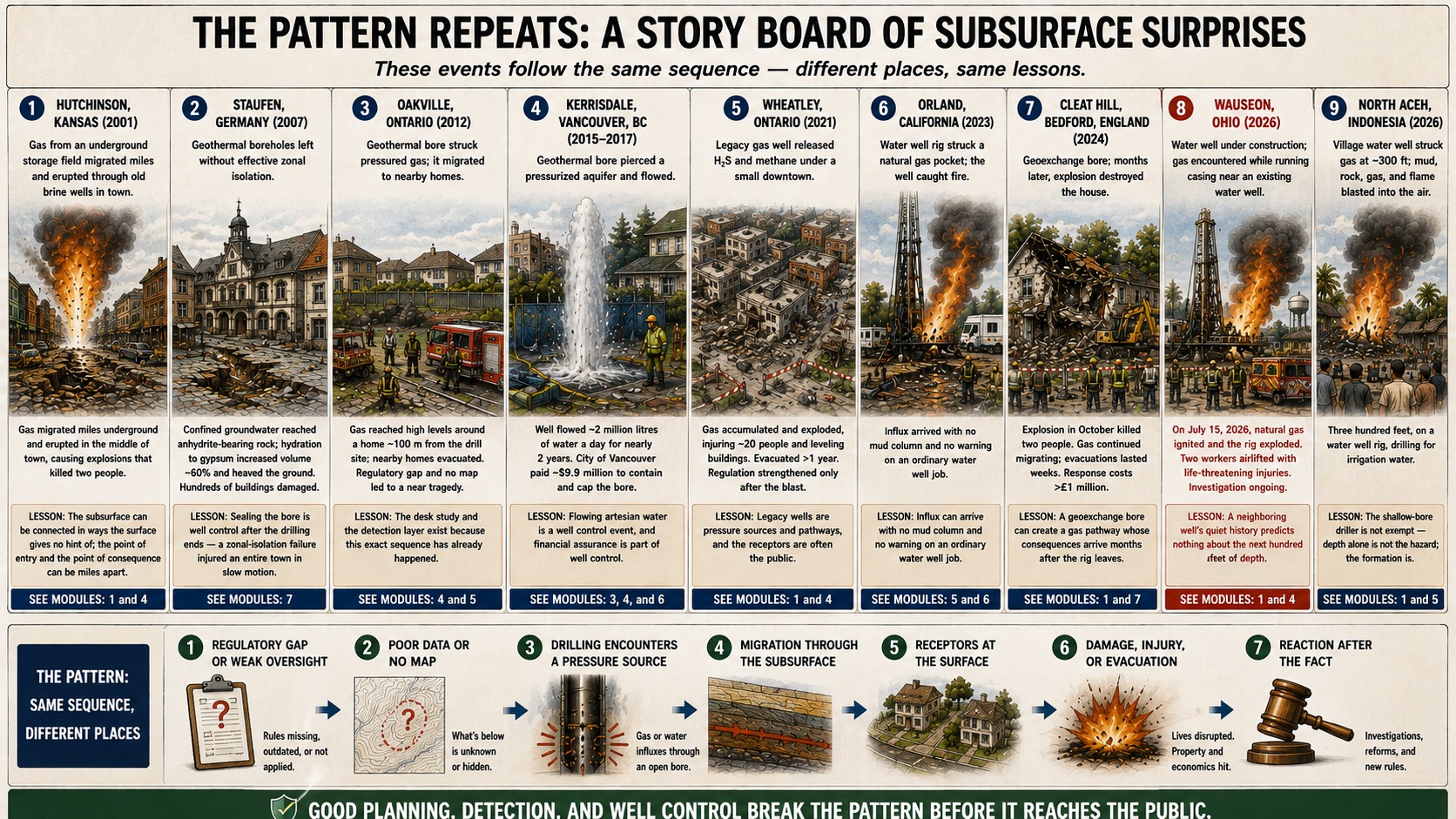
- Cleat Hill, Bedford, England (2024). Ground-source heat pump boreholes were drilled at a residential property in the summer. In October, an explosion destroyed the house and killed two people; gas continued migrating, residents were evacuated for weeks, and response costs passed £1 million. The official investigation into causation remains open, and this course will incorporate its findings when they publish. Lesson: a geoexchange bore can create a gas pathway whose consequences arrive months after the rig leaves — see Modules 1 and 7.
- Orland, California (2023). A water well drilling rig struck a natural gas pocket, and the well caught fire with the rig on it. Lesson: influx can arrive with no mud column and no warning on an ordinary water well job — see Modules 5 and 6.
- Wheatley, Ontario (2021). Hydrogen sulfide and methane from a legacy gas well accumulated beneath a small downtown and exploded, injuring roughly twenty people and leveling buildings. The town center was evacuated for over a year. The disaster forced Ontario to fund and overhaul a legacy-well program whose gaps were already documented; regulation was strengthened only after the blast. Lesson: legacy wells are pressure sources and pathways, and the receptors are often the public — see Modules 1 and 4.
- Oakville, Ontario (2012). A vertical bore for a residential geothermal heating system struck pressured natural gas between roughly 380 and 540 feet. Gas migrated through the ground and reached high levels in and around a home some 100 meters from the drill site; nearby homes were evacuated, and the fire department responded. Underground mapping had not shown the gas, and geothermal boreholes fell into a gap between the regulatory regimes then in force. The “near tragedy” pushed Oakville’s mayor and the Ontario Association of Fire Chiefs to demand provincial action, and Ontario answered with rules for geothermal and exploratory boreholes — including gas detectors on rigs. Fourteen years ago the pattern was already complete: a regulatory gap, no map, an influx, a neighborhood — then regulation. Lesson: the desk study and the detection layer exist because this exact sequence has already happened — see Modules 4 and 5.
- Hutchinson, Kansas (2001). Gas escaping from an underground storage field migrated miles through the subsurface and erupted in the middle of town through old brine wells, causing explosions that killed two people. Lesson: the subsurface can be connected in ways the surface gives no hint of; the point of entry and the point of consequence can be miles apart — see Modules 1 and 4.
- Staufen, Germany (2007). Boreholes drilled to approximately 450 feet for the town hall’s geothermal system were left without effective zonal isolation across the intervals they penetrated. The open pathways allowed confined groundwater to reach dry anhydrite-bearing rock; as the anhydrite hydrated to gypsum — a reaction that increases mineral volume by roughly sixty percent — the ground beneath the historic town center heaved. Hundreds of buildings have been damaged in the years since. No fire, no gas, and no fatalities: a zonal-isolation failure injured an entire town in slow motion. Lesson: sealing the bore is well control after the drilling ends — see Module 7.
- Fulton County, Ohio (2026). On July 15, 2026, a water well under construction near Wauseon, in the Toledo area, encountered natural gas at roughly 180 feet that ignited. Two workers were hospitalized with life-threatening injuries; two children in the home were unharmed. The incident remains under investigation; this course draws no conclusions about cause and will publish the official findings in its errata when they appear. In a televised interview, the property owner stated that an existing well on the same property had not produced gas and that the gas on the new well came as a surprise. Lesson: a neighboring well’s quiet history predicts nothing about the next hundred feet of depth — see Modules 1 and 4.
- Kerrisdale, Vancouver, British Columbia (2015–2017). A geothermal heat exchange bore for a single residential property pierced a pressurized aquifer, and the well flowed roughly two million litres of water a day. Nearly two years passed before the aquifer was finally sealed, and the City of Vancouver bore the containment and capping cost of approximately $9.9 million — for one borehole at one house. Lesson: flowing artesian water is a well control event, and financial assurance is part of well control — because when the cost of a lost well exceeds what the responsible party can cover, the public inherits it. See Modules 3, 4, and 6.
- North Aceh, Indonesia (2026). A village water well drilling project struck a gas pocket at a reported depth of roughly 300 feet. Witnesses described mud, rock, gas, and flame blasting into the air, and a major fire followed. Three hundred feet, on a water well rig, drilling for irrigation water. Depth alone is not the hazard; the formation is. Lesson: the shallow-bore driller is not exempt — see Modules 1 and 5.
0.3 The risk is not the driller’s alone
Well control failures do not respect the property lines. They can and do affect the public and can harm the innocent. Consider an illustrative hypothetical — invented for instruction, drawn from the physics and from the record rather than from any particular project.
A deep exchange bore is drilled on a green space near a multi-level underground parking structure. The bore encounters a gas-bearing zone carrying hydrogen sulfide. Under calm conditions, the gas accumulates where ventilation fails: in low, enclosed spaces — the lower levels of the garage, its stairwells, and its elevator pits. Do not use your nose to judge hydrogen sulfide: you can smell it at very low concentrations, but at higher concentrations it quickly paralyzes the sense of smell — the odor can disappear as the gas becomes lethal. The absence of odor is not evidence of safety; only a calibrated gas monitor can tell you whether the air is safe. Before anyone can act, the death toll rises.
This is not purely speculative. In December 2003, a blowout at a gas well near Kaixian, in Chongqing, China, released hydrogen sulfide from a hillside well into a populated valley. 243 people died, thousands were treated, and tens of thousands were evacuated. That story travels the control-of-well insurance world for a reason. It CAN happen because it HAS happened.
0.4 What this course is — and what it is not
This is not a certification. Certification must be earned through accredited bodies. The authors and reviewers of this course are named in its front matter, with their credentials, so that the reader may judge the source directly.
This is not a panacea. Drillers and regulators must cooperate to protect life, health, property, and the environment by identifying and mitigating risks together.
This is not an argument for a BOP on every bore. The great majority of geoexchange bores will never need one, and this course says so plainly. The skill this course teaches is identifying the bores that will.
This is not an emergency response manual. The purpose of this course is to prevent influx or to mitigate it. The out-of-control well is out of scope on purpose: its management is governed by the crew’s emergency response plan, the customer, the authority having jurisdiction, and the well control specialists whom that plan summons. This course strongly recommends that such a plan exist; it does not write it.
The goal of this course is therefore to:
- Identify the risks before drilling;
- Choose prevention and mitigation proportional to those risks;
- Document what actually happens downhole — including influx you controlled successfully; and
- Share what you encounter, so that the next crew drilling the same formation starts smarter than you did.
The objective is a culture of awareness and accountability.
0.5 Addressing Objections and Biases
“Nothing like that has ever happened nearby.” This is survivorship bias: judging the risk by the wells that went fine, while the wells that did not are someone else’s story. The Fulton County incident illustrates the point without waiting for the investigation: by the property owner’s own public account, an existing well on the same property had not produced gas, and the gas on the new well came as a surprise. The local history proved nothing about the next hundred feet of depth. Every case in Section 0.2 happened somewhere it had never happened before.
“Influx just isn’t that common in our work.” This argument sounds like data but is not — because the data does not exist. The authors are aware of no jurisdiction that requires a driller to report a gas show that was controlled, or one that never reached the finished well; readers who know of such a requirement are invited to submit it for the errata, and the course will publish it. Flow checks are not required, so their results are not recorded. Reporting is typically triggered only when someone is hurt or when gas is flowing into a completed well — and even then, brine, oil, and other contaminants may fall outside the reporting requirement entirely. Moreover, the population of deep bores that represent the higher risk remains too small to support confident claims about the absence of that risk.
Information asymmetry and economic incentives. The economic incentives point in one direction: reporting an encounter invites regulatory scrutiny, new equipment costs, and new training requirements, while not reporting costs nothing — until it does. The result is a market in which the people who hold the information (drillers who hit gas and handled it) and the people who price the risk (owners, specifiers, regulators, insurers, and the public) work from different books. Economists call that information asymmetry. Psychologists would add the availability heuristic: we judge how common something is by how often we hear of it, and this industry has built a system in which we hear of almost nothing. “I never hear about influx” and “influx is rare” are not the same sentence.
0.6 Where this course goes
- Module 1 — Pressure. Natural and induced pressure sources; traps and seals; confined aquifers and artesian prediction; buried-valley aquifers, drift gas, and reactive formations; how pressure hides and how it releases.
- Module 2 — Operationally Induced Pressures. Pressures and stresses created by the drilling operation itself, which no desk study can foresee and which are prevented only by sound practice: surge, swab, and loop insertion; chemical, mechanical, and thermal modification of the formation; and their mitigation through mud chemistry and good drilling practice.
- Module 3 — Influx fluids. Flowing artesian water, brine, methane, oil, hydrogen sulfide, and carbon dioxide; concentration-effect toxicology with cited exposure limits; the impacts of each fluid on life, health, property, and the environment.
- Module 4 — Pre-drilling risk identification. The desk study as a one-page working checklist: public data, offset and legacy wells, geologic screens, the questions to ask your authority having jurisdiction, insurance verification, and the emergency response plan requirement.
- Module 5 — Influx indicators and detection. Recognizing influx while drilling, casing, running loops, isolating zones, and after construction; induced influx, including surge, swab, and loop-insertion effects; atmospheric gas detection as the layer that shortens response time without ever substituting for well control.
- Module 6 — Influx mitigation means and methods. Primary barrier philosophy from mud weight to diverters to BOPs; diverters as flow control that buys time, never as barriers; selection strategies; pressure testing to EPA UIC and API methods, with state and local requirements controlling where they overrule; killing and plugging a flowing bore within the crew’s capability, and the boundary at which the specialists take over; contractor economics and insurance in plain terms; the emergency response plan requirement, restated.
- Module 7 — Zonal isolation. Grout and cement as barriers for every multi-aquifer bore; materials, placement, verification, and the density rule; wait-on-cement, bonding, and pressure testing summarized to the applicable API specification.
- Module 8 — Reporting. Measurement, monitoring, and the records that run the job: flow check logs, trip sheets, mud reports, test records, baseline groundwater sampling tiered to the risk screen, and a model voluntary encounter report. A documented risk creates a duty to act upon that risk; records kept for real reasons are the only records that hold up.
The course is free and open, published in installments, and licensed for anyone to teach from. Corrections are welcomed and will be incorporated appropriately.
0.7 Scope, limitations, and license
This course is educational material. It cannot replace engineering, legal, or insurance due diligence; nor is it a substitute for site-specific engineering, for the requirements of any authority having jurisdiction, or for a well control plan prepared for an actual well.
Requirements vary by jurisdiction, and the reader is responsible for identifying and complying with the requirements that govern the reader’s own work. The authors make no warranty, express or implied, and accept no liability for the application of this material.
This course is © 2026 Nathan Zenero, OXBO Energy, LLC and is licensed under the Creative Commons Attribution–NonCommercial 4.0 International license (CC BY-NC 4.0). For noncommercial purposes, you are free to copy, share, adapt, translate, and teach from this material in any medium or format, provided that you give appropriate credit, indicate whether changes were made, and do not suggest that the authors endorse you or your use. The authors consider instruction by accredited educational institutions, nonprofit associations, and public agencies to be noncommercial, and they intend this material to reach every crew that can use it. Commercial use — including the sale of this material, its incorporation into paid training products, or its use to market paid goods or services — requires the authors’ prior written permission, which the authors grant or withhold at their sole discretion; legitimate commercial trainers are encouraged to ask. Requests for commercial licensing, submissions for the public errata, and accounts of encountered influx may be sent to nathan@oxbo.energy. The full license text is available from Creative Commons at https://creativecommons.org/licenses/by-nc/4.0/(“https://creativecommons.org/licenses/by-nc/4.0/”).
Sources
- Ground Engineering — Two dead after explosion in Bedford following heat pump drilling (Nov 2024) — https://www.geplus.co.uk/news/two-dead-after-explosion-in-bedford-following-heat-pump-drilling-04-11-2024/
- UK Parliament, Hansard — Cleat Hill Heat Pump Incident debate (Nov 2024) — https://hansard.parliament.uk/commons/2024-11-21/debates/966322C3-1DED-41E1-8804-0743C1796292/CleatHillHeatPumpIncident
- Bedford Independent — Cleat Hill explosion costs reach £1m — https://www.bedfordindependent.co.uk/cleat-hill-explosion-costs-reach-1m-as-residents-demand-answers/
- Action News Now — Water drilling rig hits natural gas pocket, causes fire in Orland, CA (2023) — https://www.actionnewsnow.com/news/water-drilling-rig-hits-natural-gas-pocket-and-causes-fire-in-orland/article_cb5ee60a-88df-11ee-a843-07e1999ab29e.html
- Globe and Mail — A year after the Wheatley explosion, Ontario drafting strategy on old wells — https://www.theglobeandmail.com/canada/article-wheatley-explosion-gas-wells/
- CBC — Ontario to launch strategy to identify and plug abandoned oil and gas wells — https://www.cbc.ca/news/canada/windsor/ontario-abandoned-oil-gas-wells-wheatley-1.6863707
- HPAC Magazine — Oakville issues advisory regarding geothermal installations (May 2012) — https://www.hpacmag.com/heating-plumbing-air-conditioning-general/oakville-issues-advisory-note-regarding-geothermal-installations/1001256747/
- InsideHalton — Near tragedy sparks new drilling rules (Oakville) — https://www.insidehalton.com/news/near-tragedy-sparks-new-drilling-rules/article_c450fd87-9e2d-5d22-9d8b-f4af27b89334.html
- Toronto Star (archived PDF) — Ontario sets drill rules after Oakville geothermal gas leak (2012) — https://www.sourcewaterprotection.on.ca/wp-content/uploads/meetings/M49/Geothermal-ontario%20sets%20drill%20rules%20120519.pdf
- Kansas Geological Survey — Hutchinson Response Project background — https://www.kgs.ku.edu/Hydro/Hutch/Background/index.html
- Kansas Geological Survey — The Hutchinson Gas Explosions: Unraveling a Geologic Mystery (Allison, 2001) — https://www.kgs.ku.edu/Hydro/Hutch/Refs/Hutch_KBA_final.pdf
- Sass, I., and Burbaum, U. (2010) — Damage to the historic town of Staufen (Germany) caused by geothermal drillings through anhydrite-bearing formations — Acta Carsologica 39(2), open access — https://ojs.zrc-sazu.si/carsologica/article/view/96
- Goldscheider, N., and Bechtel, T.D. (2009) — Editors’ message: The housing crisis from underground — damage to a historic town by geothermal drillings through anhydrite, Staufen, Germany — Hydrogeology Journal 17:491–493 — https://link.springer.com/article/10.1007/s10040-009-0458-7
- Cleveland 19 — Two hospitalized with life-threatening injuries after well drilling explosion, Fulton County OH (July 2026) — https://www.cleveland19.com/2026/07/16/two-hospitalized-with-life-threatening-injuries-after-well-drilling-causes-explosion-wauseon/
- YouTube — Televised interview with the Fulton County property owner (owner states the existing well had not produced gas; at ~0:40) — https://www.youtube.com/watch?v=J90Q0wS3HdQ
- WHIO TV 7 — Natural gas explosion injures two in Fulton County (July 2026) — https://www.whio.com/news/local/two-workers-seriously-injured-ohio-natural-gas-explosion/RZUNICUOUNCTJO5OTCJROWRXYU/
- WTOL 11 — Two workers seriously injured in natural gas explosion in Fulton County (July 2026) — https://www.wtol.com/article/news/local/fulton-county-sheriffs-office-responds-to-explosion-in-wauseon-wednesday-afternoon/512-57c4966f-e8d6-460b-82ac-4e61e1b718dc
- Northwest Signal / Bryan Times — Well explosion in Wauseon caused by drilling into gas pocket (well depth ~180 ft, per Fire Chief Kessler) — https://www.northwestsignal.net/news/article_fd0c1426-6789-4712-b31e-50cef1810981.html
- CBC — City of Vancouver on hook for cost of capping massive groundwater leak (Kerrisdale geothermal bore, 2015–2017) — https://www.cbc.ca/news/canada/british-columbia/city-of-vancouver-on-hook-for-10-million-cost-of-capping-massive-groundwater-leak-1.4997907
- CBC — City of Vancouver expects to rack up $9.9M repair bill for burst aquifer — https://www.cbc.ca/news/canada/british-columbia/aquifer-repair-1.4095259
- ANTARA (Indonesian news agency) — Borehole erupts with fire in Aceh (2026) — https://www.antarafoto.com/view/2792937/borehole-erupts-with-fire-in-aceh
- Safety Science — The unfolding of the “12.23” Kaixian blowout accident in China — https://www.sciencedirect.com/science/article/abs/pii/S0925753508002208
- China Daily — Tragedy of errors in gas blowout (Jan 2004) — https://www.chinadaily.com.cn/en/doc/2004-01/12/content_297948.htm
- ReliefWeb / IFRC — China: Gas Well Explosion in Chongqing, Information Bulletin No. 1 (2003) — https://reliefweb.int/report/china/china-gas-well-explosion-chongqing-information-bulletin-n-1
- ANSI/ASSP Z390.1 — Accepted Practices for Hydrogen Sulfide (H2S) Training Programs (referenced for gas-behavior training doctrine)