
Author: Nathan Zenero, OXBO Energy, LLC
Audience. Written for working geoexchange and water-well drillers and their crews, and for the contractors, design engineers, specifiers, and regulatory authorities who share responsibility for the boreholes they construct.
Records
Module 4 directed the driller to prepare a prognosis at the desk before drilling began. That prognosis holds the formation tops, the pressure gradients, the aquifers, and the fluids the subsurface may carry. It describes the subsurface in detail. It does not record the well-control events that earlier crews encountered in the same ground.
For the next crew, the account of an offset bore is more informative than any gradient chart. The crew that drilled the offset learned where the gas entered, what mud weight held the formation, and what weight stopped the gas once it moved. That account is among the most valuable inputs a driller can carry to a new bore. It is almost never recorded. The fragments that are recorded are not shared.
8.1 The Record That Is Not Kept
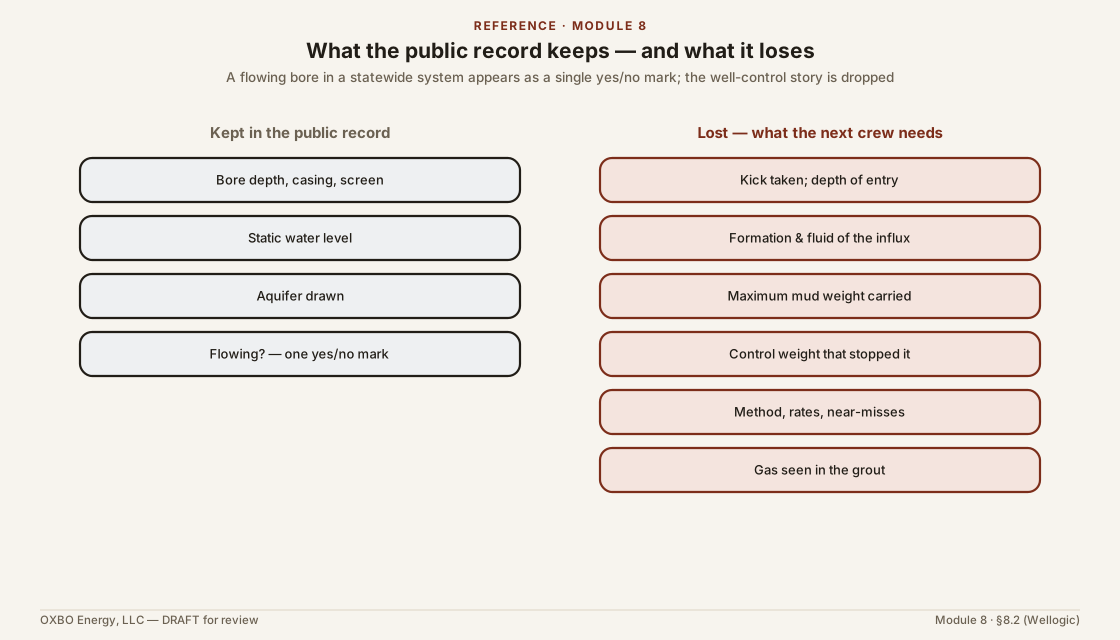
A driller who prepares thoroughly can still begin a bore without the information that matters most. The prognosis is built from drillers’ logs, geologic maps, and the records the state keeps. Those records describe construction. They report the depth of a bore, its casing, its screen, its static level, and the aquifer it draws. They do not report a kick, the weight the crew mixed to hold one, the fluid that entered, or the depth at which it entered. A driller can read every log within a mile without learning that a nearby bore unloaded gas at four hundred feet.
Records capture only what regulation requires. No rule requires a driller to record a well-control event that injured no one.
8.2 What the Law Requires, and What It Does Not
To the author’s knowledge, no federal rule requires a water-well or geoexchange driller to report a well-control incident that caused no injury. Federal reporting turns on harm to a person. The Occupational Safety and Health Administration requires a report when an incident kills a worker or sends one to the hospital. It requires nothing when a bore unloads gas without injuring anyone. The environmental rules that apply to this work address contamination. They do not address loss of control.
A few states impose additional duties. Wisconsin requires a driller to notify the department at once when a flowing well is not contained by the planned construction. New Mexico requires immediate notice to the state engineer when an artesian stratum is struck. Louisiana requires a report within a day when gas vents at the bore. Missouri requires notice when drilling encounters oil or gas. Each of these is a genuine duty. None narrows the general absence of a recording requirement. Each notice exists to get the flow capped or the gas permitted. None asks for the mud weight that held the formation, the depth or fluid of the influx, or the weight that stopped it. The notice reaches a regulator. It does not reach the next driller. This survey covers the federal rules and the state codes as the author read them. A driller should confirm the duty in the jurisdiction where he works.
Where the subsurface record is captured at all, it is captured in little detail. Michigan keeps the largest water-well record system in the country, more than a million bores, open to the public through a live data service. A flowing bore in that system appears as a single yes-or-no mark. The flow rate the driller wrote on the paper form is dropped from the public data. The data hold no field for gas. The remarks line, where the account would go, is empty. A researcher can learn that a bore flowed. The record does not show why it flowed, from what depth, at what pressure, or how the crew regained control.
8.3 What to Record
The record worth keeping is the one a driller would want to find. Every entry should be judged by that standard. A fact belongs in the record if it would help the next crew on this ground, or if it would have helped the present crew to have read it beforehand.
The core of the record is the well-control history of the bore. It is short. It states the maximum mud weight the crew carried and any influx the crew took, with the influx’s depth of entry, formation of origin, and fluid, whether gas, water, brine, or oil. It gives the first indicator that showed the influx, the means of detection, the mud weight that brought the influx under control, and the method used. Where the bore had no window, the history states that fact and what the crew did in place of weighting.
Additional context makes that core usable. The full record is set out below.
| Field | What to record |
|---|---|
| Bore and location | Identifier, coordinates, date, driller |
| Prognosis versus found | Formation tops expected, and the tops actually met |
| Maximum mud weight | The highest density carried, with the ECD where it is known |
| Influx — depth | The depth at which fluid entered |
| Influx — formation | The formation of origin |
| Influx — fluid | Gas, water, brine, or oil |
| First indicator | The sign that showed the influx, and how it was detected |
| Control weight | The mud weight that stopped the flow |
| Method | How control was regained, with the steps and the rates |
| Fracture limit | The MAMW or shoe test, and whether a window existed |
| Near-misses | Losses, swabbing, drilling breaks, and cavings |
| Zonal isolation | Returns achieved, top-off performed, and any gas seen in the grout |
The record requires no new measurement. Every line is a number the crew already read while drilling, from the instruments of Module 5 and the control method of Module 6. It requires only that each number be written down and retained.
8.4 Why It Pays the Driller Who Keeps It
The first crew to benefit from the record is the crew that wrote it. The kill weight found on one bore is the starting weight for the next bore on the same pad. Module 6 established that point at the rig. A written record preserves it beyond the shift. A driller who keeps the history of a field approaches each new bore knowing the conditions earlier bores encountered there. A driller without that history begins each bore uninformed.
The record also protects the driller who kept it. A documented bore records the readings taken and the reasoning behind each decision. It demonstrates careful work if that work is ever questioned. A driller who kept no record cannot demonstrate the same.
8.5 The Next Man Up
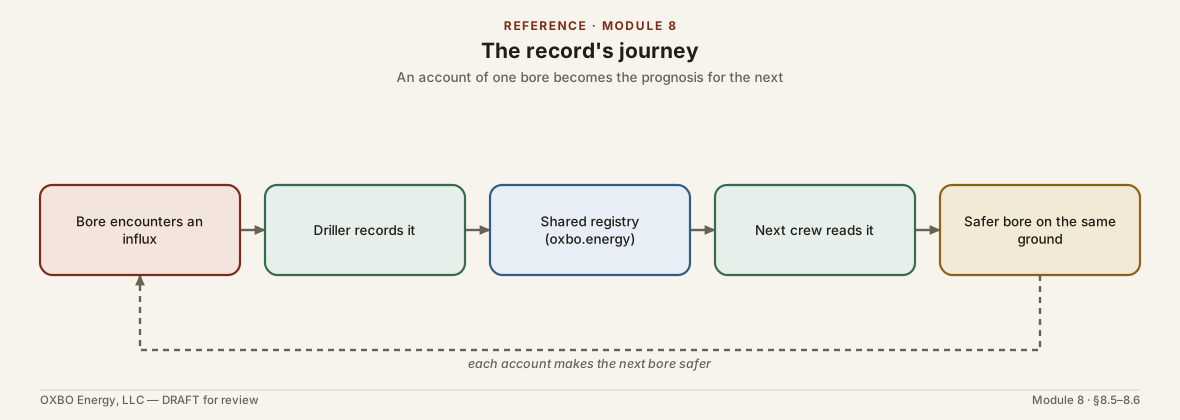
A trade improves by recording and studying its incidents. Without such records, the same incidents recur. Geoexchange keeps no shared record of its well-control incidents. Each crew encounters the conditions the previous crew faced. Each incurs the same cost to overcome them. The repetition ends only when the record is shared.
A driller should record what he would want to find. A driller who has spudded a bore wishing he knew what the last crew encountered will know what to write for the crew that follows. A single account has limited value. A thousand accounts, indexed by ground and by formation, document where well-control problems have occurred across the trade and how crews regained control.
8.6 Where the Record Goes
A shared record requires a repository. At present none exists. Neither a state agency nor a trade body maintains one. Until one does, OXBO Energy will host a voluntary registry of geoexchange and water-well control incidents, open to any driller, at oxbo.energy. An account may be entered under the contributor’s name or without it. The aim is to transfer the registry to a university or a standards body once it has grown, so that it remains independent of any single company.
A contribution can be as short as a single influx or as full as a field’s history. An account of an encountered influx, sent to the address in this module’s license, becomes part of that record. By submitting one, a driller gives the next crew information that no regulation requires him to record.
Tap a map, then give depth, event type, fluid, and an estimated pressure. No name, no company, no address. Two minutes, and the next crew drilling your formation learns from your bore.
Open the anonymous report form →Key References
- Occupational Safety and Health Administration. Recording and Reporting Occupational Injuries and Illnesses, 29 CFR 1904.39 (report triggered by fatality or in-patient hospitalization, not by a well-control event).
- U.S. Environmental Protection Agency. Underground Injection Control Program, Class V wells (reporting keyed to endangerment of drinking water, not loss of control).
- Wisconsin Department of Natural Resources. Well Construction and Pump Installation, Wis. Admin. Code NR 812.15 (notice of an uncontained flowing well) and NR 812.25 (heat-exchange drillholes).
- New Mexico Office of the State Engineer. N.M. Admin. Code 19.27.4.31 (notice when an artesian stratum is encountered).
- Louisiana Office of Conservation. La. Admin. Code Title 56, Part I, §323 (report of gas at the bore).
- Missouri Revised Statutes §256.614 (notice when oil or gas is encountered in drilling).
- Michigan Department of Environment, Great Lakes, and Energy. Wellogic statewide water-well records system.
The statutory citations above are current to the author’s knowledge and are jurisdiction-specific; confirm the governing rule before relying on it.
This module is © 2026 Nathan Zenero, OXBO Energy, LLC and is licensed under the Creative Commons Attribution-NonCommercial 4.0 International license (CC BY-NC 4.0), on the terms stated in Module 0. Requests for commercial licensing, submissions for the public errata, and accounts of encountered influx may be sent to nathan@oxbo.energy.